SEO vs GEO How Generative Engine Optimization Is Changing Search in 2026
Search is not what it used to be. People are no longer typing a query into Google and scrolling through ten blue links. A growing number of them are asking ChatGPT, Perplexity or Google AI Overviews directly and getting a full answer in seconds. No clicking. No scrolling. Just an answer.
This shift has given rise to a new discipline: Generative Engine Optimization (GEO). And if you have not heard of it yet, you are already behind. Understanding SEO vs GEO is no longer optional in 2026. It is table stakes.
What Is GEO and Why Does It Exist?
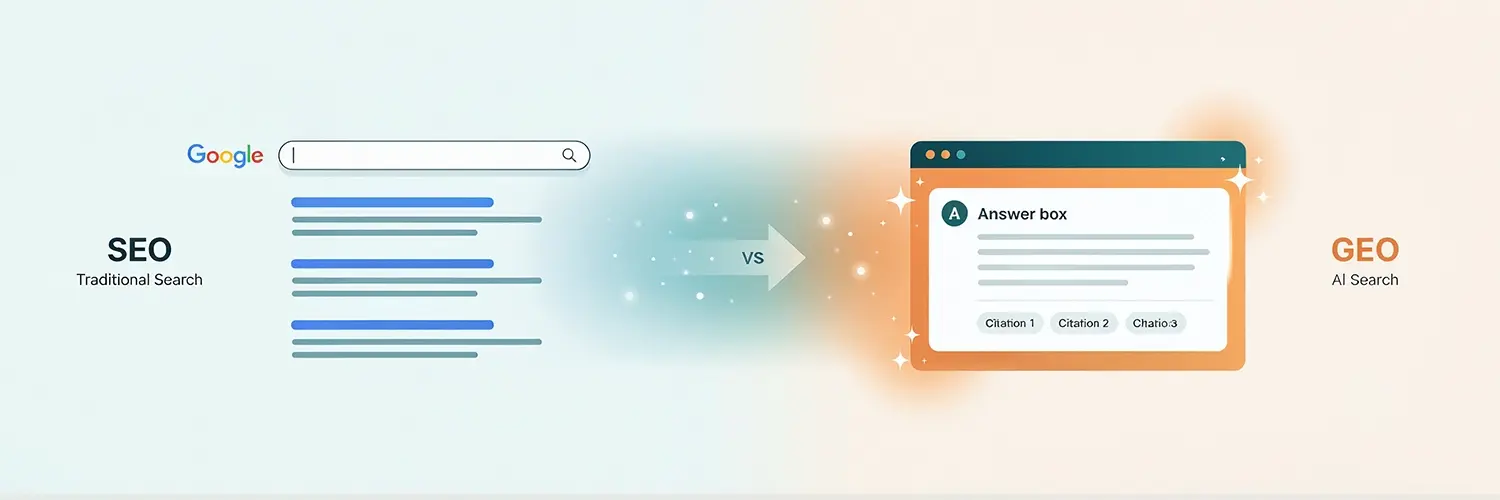
GEO, or AI search optimization, is the practice of structuring your content so that AI engines like ChatGPT, Perplexity, Gemini, and Google AI Overviews cite it when answering user questions.
Traditional SEO gets your page to rank on Google. GEO gets your brand mentioned inside the AI-generated answer itself.
The difference matters because 37% of consumers now start their searches with AI tools instead of Google and ChatGPT alone has crossed 900 million weekly active users. That audience is not seeing a list of links. They are seeing one synthesized answer and if your brand is not in it, you simply do not exist for that search.
What Is SEO and How Does It Work?
SEO or Search Engine Optimization is the process of optimizing your website and content so Google ranks it higher in search results. The higher you rank, the more people click through to your site.
It works through three pillars: the right keywords in your content, quality backlinks from other sites pointing to yours and strong technical foundations like site speed, mobile-friendliness and clean structure.
For over two decades, SEO has been the primary way businesses get discovered online. It still is, but it is no longer the only way.
SEO vs GEO: The Core Difference
Both disciplines share the same content quality foundation, but the goals, metrics and tactics differ in important ways.
| Factor |
Traditional SEO |
Generative Engine Optimization (GEO) |
| Primary Goal |
Rank in Google search results |
Earn citations in AI-generated answers |
| Key Metric |
Organic traffic and click-through rate |
Citation rate across AI engines |
| Optimization Focus |
Keywords, backlinks, on-page SEO |
Semantic structure, fact density, topical authority |
| User Experience |
User clicks link, lands on page |
User gets answer directly (zero-click search) |
| Success Signal |
High ranking + click |
Brand mentioned by name inside AI answer |
The most important shift is that GEO operates in a zero-click search environment. Users get their answer directly from the AI, so brand mentions and citations often matter more than raw traffic numbers.
Why This Matters in 2026 (The Numbers)
The numbers tell the story clearly. ChatGPT now processes more than 900 million visits per week and Gartner predicts a 25 to 30 percent decline in traditional Google search volume by the end of 2026. Click-through rates for informational queries are dropping in sectors where Google AI Overviews appear.
For businesses, this creates both a risk and an opportunity:
• Brands invisible to AI search engines lose access to a fast-growing share of buyer research
• Brands cited by AI engines gain trust through implicit endorsement
• The overlap between top Google rankings and AI-cited sources has dropped from 70 percent to under 20 percent in recent industry research
• Early movers in GEO capture authority positions that latecomers struggle to displace
For agencies and businesses still focused exclusively on traditional SEO, the opportunity to establish AI search visibility is open right now. Partnering with a team that delivers both traditional SEO and digital marketing services can help bridge that gap before competitors catch on.
How AI Engines Decide What to Cite
This is where most marketers go wrong. They assume AI works like Google. It does not.
It Breaks Your Question into Sub-Queries
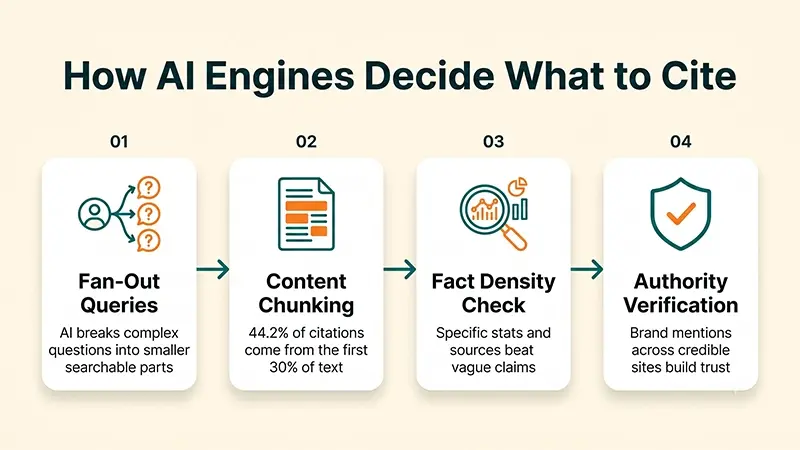
When someone asks an AI a complex question, it does not search for one answer. It runs what are called fan-out queries, breaking the question into smaller parts and pulling sources that answer each part clearly. If your content answers those sub-questions directly, you get pulled in. If it is vague or buried under fluff, it gets skipped.
It Reads in Chunks, Not Pages
AI systems process content in chunks. 44.2% of all citations come from the first 30% of a text the introduction. That means your opening section carries the most weight. If your key point is buried in paragraph seven, an AI engine will likely never surface it.
It Rewards Fact Density Over Keyword Density
Vague claims get skipped. Specific statistics, sourced data and named examples get quoted. This is content chunking for AI in practice: tight, verifiable, well-structured information that an AI can lift directly into an answer.
It Checks Authority Before Citing
Branded web mentions have the strongest correlation with AI Overview appearances much stronger than backlinks. The more your brand is mentioned across credible publications, the more AI engines trust citing you. This is semantic search relevance working at a brand level, not just a page level.
E-E-A-T Signals Matter More Than Ever
Google's E-E-A-T framework (Experience, Expertise, Authoritativeness, Trustworthiness) was always important for rankings. For GEO and large language model optimization, it is important.
AI engines are risk-averse. They do not want to cite a source that turns out to be wrong. So they prefer:
• Content with clear author credentials and bylines
• Pages that cite external data and research
• Brands that are consistently mentioned across multiple credible sources
• Organizations with clear contact information and verifiable expertise
• Original insights and data not found elsewhere
Working with an experienced digital partner that understands both traditional SEO and emerging AI search optimization helps brands navigate this transition without losing existing rankings.
The good news: if you have been building strong SEO for years, your E-E-A-T signals carry over directly to AI citation potential.
GEO vs AEO: Not the Same Thing
These two get confused constantly. Here is the quick distinction:
AEO (Answer Engine Optimization) targets featured snippets and direct answer boxes in Google the kind of answer that appears at the top of a results page.
GEO targets citations inside fully AI-generated responses from tools like ChatGPT, Perplexity and Gemini, where there is no results page at all.
Both matter. Both build on the same content quality foundation. Running both alongside traditional SEO is the smartest play in 2026 not choosing one over the others.
Practical GEO Strategies You Can Start Now
Lead With the Answer
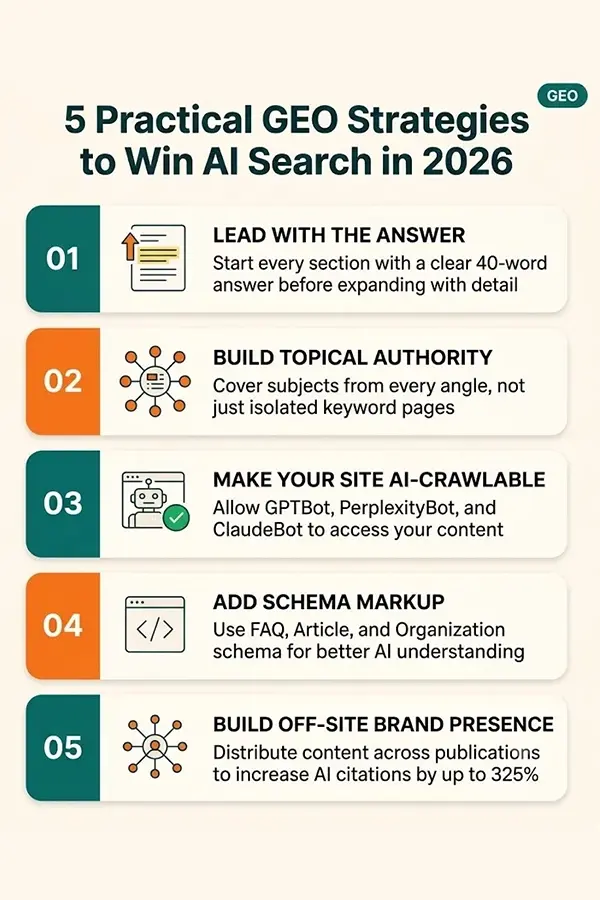
Start every section with a direct, clear answer in 40 words or less, then expand with detail. AI systems pull from the top of a section first. Give them something worth citing immediately.
Build Topical Authority, Not Just Keyword Pages
One article does not establish expertise. A content cluster that covers a subject from every angle does. AI engines reward depth across a topic far more than isolated keyword wins.
Make Your Site AI-Crawlable
73% of businesses are effectively invisible in AI search, in part because AI crawlers are silently blocked by default bot-protection settings. Check that GPTBot, PerplexityBot and ClaudeBot can actually access your site. Many cannot, and the brands do not even know it.
Add Schema Markup
FAQ schema, Article schema and Organization schema help AI engines understand exactly what your content covers, who wrote it and why it should be trusted. This is low-effort, high-impact.
Build Your Brand Presence Off-Site
Get mentioned in industry publications, directories and credible third-party sources. Distributing content to a wide range of publications can increase AI citations by up to 325% compared to only publishing on your own site.
Who Should Adopt GEO First?
GEO delivers the fastest returns for businesses where customers research before they buy. SaaS companies, digital marketing agencies, e-commerce brands, healthcare providers and professional service firms are seeing the strongest early results from GEO services in 2026. If someone Googles you before calling you, they are probably asking an AI about you first.
Generative AI search ranking is not a future investment. It is a current one. The businesses building for it now are locking in authority positions that latecomers will struggle to displace.
Is GEO Replacing SEO?
No. And anyone telling you otherwise is selling something.
GEO and AEO enhance rather than replace SEO, as generative engines rely on many of the same authority and relevance signals that traditional search algorithms use. Strong SEO foundations feed directly into GEO outcomes. The brands winning in 2026 are not choosing between them. They are running both.
The future of search is not one platform. It is spread across Google, AI engines and hybrid experiences that combine both. Your content needs to be built for all of it.
Common GEO Mistakes Businesses Make
Two mistakes come up more than any others.
The first is treating GEO as a replacement for SEO. It is not. The two strategies feed each other and brands that abandon SEO foundations in favour of GEO lose both.
The second is measuring only traffic. Citation rate is the new performance metric in AI search. If you are only tracking clicks and rankings, you are flying blind on half your search visibility.
The Future of Search in 2026 and Beyond
Search has not died. It has evolved.
Some queries remain on Google. Others are increasingly being answered by AI engines. The businesses that adapt will be the ones cited, recommended and trusted across both environments.
The future of SEO in the AI era belongs to brands that can rank on Google while also earning visibility across ChatGPT, Gemini, Perplexity and Google AI Overviews.
At Digital Hyperlinks' SEO and AI search optimization team, we help businesses prepare for both traditional search and AI-driven discovery through SEO, GEO, content strategy and authority-building campaigns designed for the future of search.
Frequently Asked Questions
1. What is the difference between SEO and GEO?
SEO ranks your page in Google results, GEO gets your brand cited inside AI-generated answers from tools like ChatGPT and Perplexity.
2. Is GEO replacing traditional SEO in 2026?
No, GEO works alongside SEO since AI engines rely on the same authority and content quality signals Google does.
3. How do AI engines decide what to cite?
They prioritize fact-dense, clearly structured content from authoritative sources that answer questions directly and early in the text.
4. What is the citation rate and why does it matter?
Citation rate is how often your brand gets referenced inside AI answers and it is the new visibility metric that traditional rankings cannot measure.
5. How quickly can GEO show results?
High-authority content can earn initial AI citations within weeks, with consistent visibility typically building over three to six months.